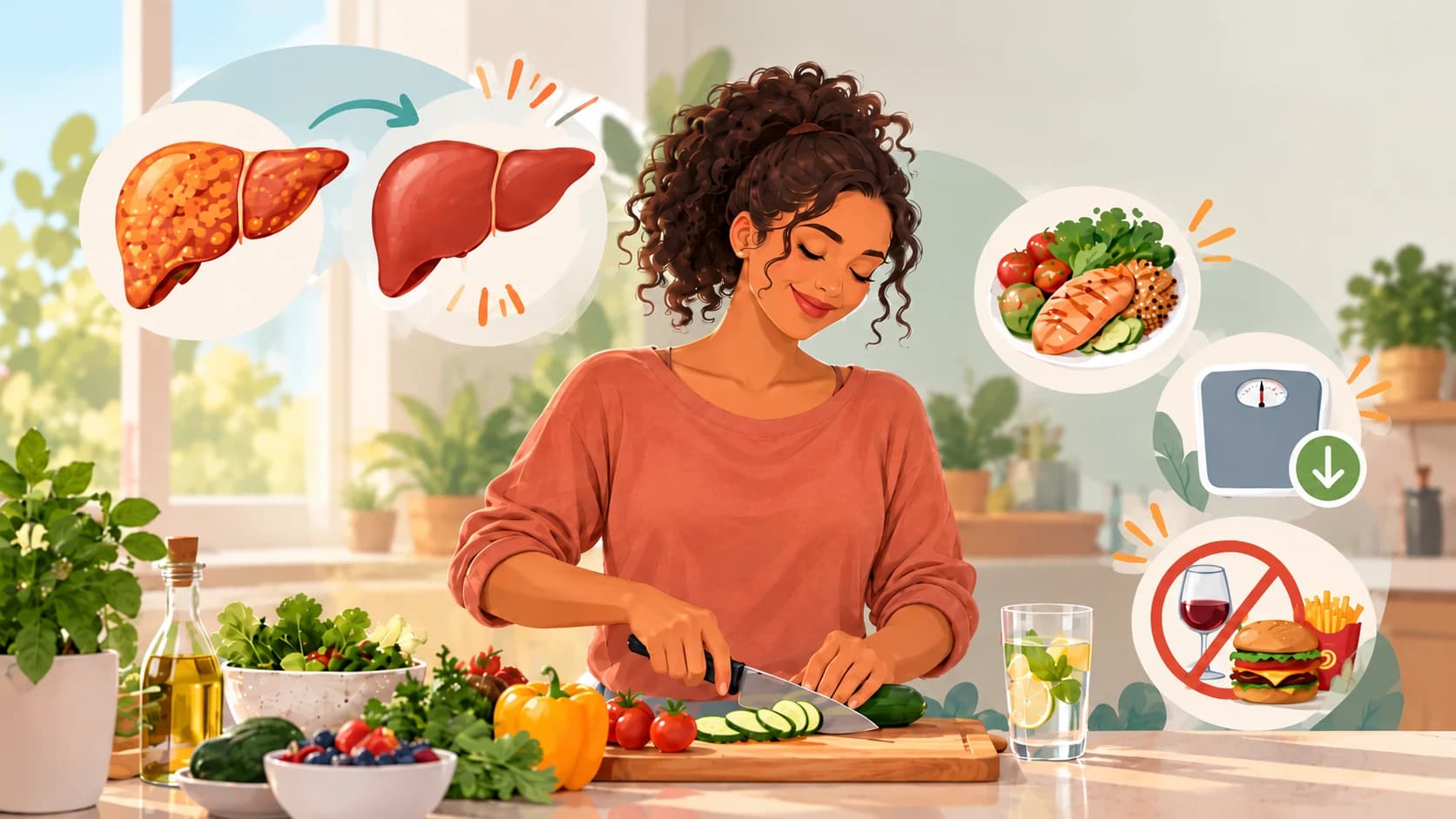

Fatty liver disease is increasingly common in people in their 20s and 30s, and it is usually silent — found on routine labs or an incidental ultrasound rather than because someone felt unwell. Most cases are metabolic rather than alcohol-related. The good news is that early disease is often reversible, and modest weight loss is the single most effective treatment there is.
Key takeaways
You do not need to drink to have a fatty liver. Most cases are metabolic in origin.
It is usually silent — mildly raised liver enzymes are often the only sign.
The condition was renamed in 2023; you may see MASLD or MASH on your results.
Losing 5 to 10 percent of body weight can meaningfully reverse early disease.
Sugary drinks, particularly those sweetened with fructose, are a bigger driver than dietary fat.
Fatty liver disease used to be something I talked about mostly with older patients. Now I am seeing it in people in their 20s and 30s across the Houston area. That shift matters, because this condition can be silent for years while it slowly causes damage.
The most common form is linked to weight, diet, and how the body handles sugar and fat. You do not have to have alcohol-related liver disease to have a fatty liver. In fact, many of my patients with this diagnosis drink little or no alcohol.
A note on the name
If your results or your chart use unfamiliar letters, that is because the terminology changed in 2023. What used to be called non-alcoholic fatty liver disease, or NAFLD, is now metabolic dysfunction-associated steatotic liver disease — MASLD. The more advanced inflammatory form, previously NASH, is now MASH.
The renaming was deliberate. Defining a common condition by what it is not, alcohol, obscured the fact that it is fundamentally a metabolic problem, sitting in the same family as insulin resistance, high triglycerides, and type 2 diabetes. Same condition, clearer name.
Why it is showing up younger
Fat accumulates in the liver when it receives more energy than it can process, particularly in the presence of insulin resistance. Fructose is handled almost entirely by the liver, which is why sweetened drinks matter more here than they do for most conditions. Add a largely sedentary day, and the metabolic setup is in place well before anyone is old enough to expect liver problems.
The problem is that most people feel fine. Fatigue, mild discomfort under the ribs, or slightly abnormal liver enzymes on blood work are often the only clues. That is why routine labs matter, and why I do not think of them as something that only starts mattering at 40.
How it gets diagnosed
Usually it starts with mildly elevated ALT or AST on a metabolic panel, or with fat noticed on an ultrasound ordered for something else entirely. Neither finding tells us how much damage there is, which is the question that actually matters.
From there we rule out other causes — viral hepatitis, alcohol, medications, thyroid disease — and estimate the risk of scarring using a simple calculation based on your age, platelets, and liver enzymes. Most young patients come out at low risk, which is reassuring and means we focus on reversing it rather than on more testing. Higher scores warrant a specialist and more detailed assessment of liver stiffness.
What I tell younger patients in Cypress
If you are overweight, ask your doctor whether your liver enzymes have been checked.
Sugary drinks and ultra-processed food are bigger drivers than most people think.
Weight loss, even modest, can improve or reverse early disease. Around 5 percent begins reducing liver fat; closer to 10 percent is where inflammation and early scarring tend to improve.
Exercise helps, even before the scale moves much. Resistance training and moderate cardio both reduce liver fat independently of weight change.
Be careful with alcohol. Even if it did not cause this, it adds to the same injury.
This is one of those conditions where early action pays off. If you catch it before significant damage, the liver can recover more than people expect.
Common questions
Can fatty liver be reversed?
In its early stages, frequently yes. Liver fat responds well to sustained weight loss and reduced sugar intake. Once significant scarring has developed the picture changes, which is the argument for finding it early rather than waiting for symptoms.
Is there a medication for it?
The field has moved recently, and there are now drug options for the more advanced inflammatory form in appropriate patients. For early disease, lifestyle change remains the primary treatment and outperforms anything in a bottle. Whether medication fits your situation is a conversation based on your actual staging, not your diagnosis label.
I'm not overweight. Can I still have it?
Yes. Lean fatty liver exists and is well described, particularly with insulin resistance, high triglycerides, or a strong family history. A normal BMI does not rule it out.
Does it mean I'll get cirrhosis?
Most people with fatty liver never progress that far. A minority develop inflammation and then scarring over years to decades. Knowing which group you are in is what the risk assessment is for — and the things that change your trajectory are the same ones that improve your metabolic health generally.
How we can help
At FloMD Primary Care in Cypress, we check liver enzymes as part of routine metabolic labs, work out whether abnormal results need further evaluation, and build a plan around diet, activity, and where appropriate our medical weight management program. Because this travels with insulin resistance, it is worth reading alongside our post on what prediabetes means and how to reverse it.
