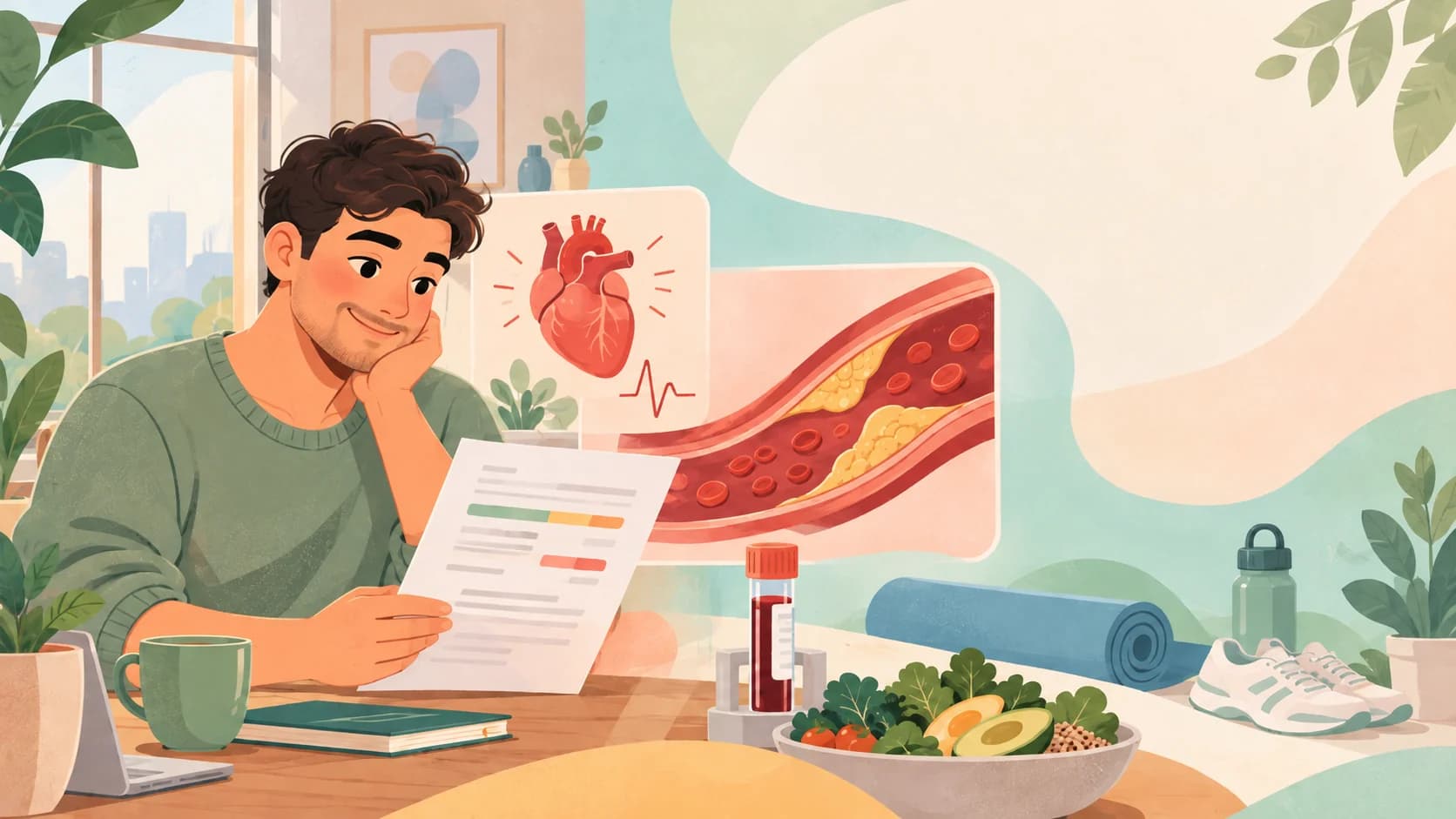

Yes, you should know your cholesterol numbers in your 30s, even if you feel fine. The 2026 ACC/AHA cholesterol guideline recommends routine lipid testing through adulthood and a one-time lipoprotein(a) test for every adult, and it puts new emphasis on treating high cholesterol earlier in life. Cholesterol damage is cumulative: what matters is how high your levels are and for how many years, so your 30s are when change buys the most.
Key takeaways
Adults should have a lipid panel at least every five years, more often if anything is borderline.
Every adult should have lipoprotein(a) checked at least once. It is largely genetic and is not part of the standard panel.
Cholesterol risk is cumulative — years of exposure matter, not just the number in a given year.
A family history of early heart disease is the strongest reason to test sooner rather than later.
The 2026 guideline supports earlier treatment for young adults with LDL of 160 or higher or high long-term risk.
Most people do not think about cholesterol in their 30s. I get it. You feel fine, you are busy, and heart disease feels like a problem for later. But I have started seeing cholesterol issues earlier and earlier in patients around Cypress.
What changed in 2026
In March 2026 the American College of Cardiology, the American Heart Association, and several other societies published a new guideline on managing cholesterol, replacing the 2018 version. Three changes matter most for people in their 30s.
First, it recommends measuring lipoprotein(a) at least once in every adult. Lp(a) is a cholesterol-carrying particle whose level is mostly set by your genes, it raises heart attack and stroke risk independently of LDL, and a standard lipid panel does not include it. Because it barely changes over a lifetime, one test is usually enough.
Second, it puts more weight on lifetime risk rather than only the next ten years. A ten-year estimate makes almost every 35-year-old look low risk, which is exactly how people end up with decades of untreated high cholesterol. The newer approach also looks at 30-year risk for adults in their 30s through 50s.
Third, it supports starting treatment earlier in young adults with an LDL of 160 or higher, a strong family history of heart disease, or a high long-term risk estimate, rather than waiting until middle age. Lifestyle change remains the first step for most people.
Signs it is more urgent
Everyone should know their numbers, but these make it worth testing sooner rather than later:
A parent or sibling had heart disease, a stroke, or high cholesterol at a young age.
You are overweight, especially around the midsection.
You have high blood pressure or borderline blood sugar.
You had gestational diabetes or preeclampsia during a pregnancy.
You smoke or vape.
You eat a lot of fast food, processed meals, or fried food.
You are mostly sedentary because of work or commuting.
One pattern deserves its own mention: an LDL of 190 or higher, especially with a family history of early heart disease, can point to familial hypercholesterolemia, an inherited condition that runs in families and is very treatable once identified. If that is you, your parents, siblings, and children should be tested too.
What the test involves
A basic lipid panel is simple. It is just blood work. But it gives you a picture of your LDL, HDL, triglycerides, and overall risk, and many labs no longer require fasting for it. Adding lipoprotein(a) is a single extra test on the same draw. In some situations an apolipoprotein B test is also useful, particularly when triglycerides are high or the standard numbers do not match the overall picture. We cover what the standard values mean in our post on five labs worth tracking.
If your numbers are borderline in your 30s, that is the easiest time to change the trajectory. Diet, activity, weight, and not smoking all move LDL and triglycerides, and the changes have decades to pay off.
I would rather help a 35-year-old in Cypress adjust their diet and activity now than manage a heart attack at 52. Prevention is boring. It is also a lot better than the alternative.
Common questions
I'm thin and active. Do I still need to check?
Yes. Lifestyle shapes cholesterol, but genetics sets a lot of it, and lipoprotein(a) in particular is almost entirely inherited. Plenty of fit people carry high LDL or high Lp(a) without any outward sign.
What if my lipoprotein(a) comes back high?
It changes how seriously we treat everything else. Diet and exercise do not lower Lp(a) much, so the focus becomes driving down the risk factors you can control, especially LDL and blood pressure. It is also worth telling your family, since it is inherited.
Will I have to take a statin in my 30s?
Most people with mildly elevated cholesterol in their 30s start with lifestyle changes. Medication becomes part of the conversation with an LDL of 160 or above, an inherited cholesterol disorder, a strong family history, or a high long-term risk estimate. It is a shared decision, not an automatic one.
Is a cholesterol test covered by insurance?
A lipid panel ordered as preventive screening is commonly covered. Lipoprotein(a) coverage is more variable because routine testing is newer, so if cost matters, we can check before ordering it.
If you are in your 30s and have never had your cholesterol checked, or had it done years ago, schedule a visit at FloMD Primary Care in Cypress. If heart disease runs in your family, our post on managing blood pressure covers the other major risk factor worth getting ahead of.
